
Scott's Pizza Tour Pizza News

Midday Pizza Making

February 21, 2011

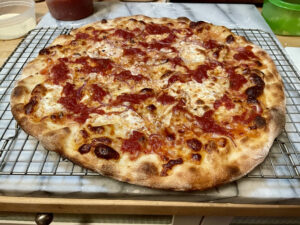
I had some surplus dough left over so my homeslice Bryan came over and we made a couple pies for lunch. We usually have pizza making sessions at night so this was a nice change of pace. New York was balmy (62 degrees F) so we ate outside!

The dough was a super simple no-frills recipe:

297g flour (King Arthur All Purpose)
196g water (just under room temp)
9g salt (standard Baleine fine sea salt)
3g yeast (regular instant dry yeast)

mixed it, kneaded it, balled it, fridged it overnight, let it rise for 2-3 hours at room temp before baking


My Best Dough Yet

January 31, 2011

If you asked me about making my own pizza around this time last year, my response would have been something along the lines of “I deal exclusively in O.P.P. or Other People’s Pizza.” To be fair, I knew that pizza making would lead me down a strange and mysterious path that would exponentially grow my pizza obsession, for better or for worse. I had plenty of excuses but the real reason was simple. I was afraid. Dough is so simple to make, yet endlessly challenging because of all the variables associated with its production. But once you get your hands on a good batch of dough, you just never go back.

The point of no return for me came in the form of a pizza making class I took at Pizza a Casa in the Lower East Side. It amazed me by simplifying the entire process into a form that was - both literally and figuratively - digestible. Fast forward ten months and now I’m experimenting with different dough hydration and yeast varieties. I have become exactly what I was afraid of and I couldn’t possibly be any happier.

I’ve made good batches and I’ve made bad batches, constantly in search of the perfect crispy-chewy texture and a salty-smokey flavor. Some batches would have the flavor while others would have the texture. I felt like I didn’t have control of anything and my life was in a tailspin — until my pal Brooks showed up with a batch of dough and an Ischia starter. WHAT THE HECK IS AN ISCHIA STARTER? That’s easy. Yeast is a fungus that floats through the air looking for a nice place to live and sometimes people build little yeast traps and put the little guys to work. The “nice place to live” can be a grape skin or apple peel and the trap is a cup half filled with a mixture of flour and water. Once the yeast start moving into their new watery-floury home, they get “put to work” on the fermentation plantation, where they feed on the natural sugars released by the reaction of water and flour and produce carbon dioxide and alcohol.

See those bubbles in the cup? Those are the product of yeast burps! Anyway, this bubbling goo is your “starter” and the particular one I am using came from an island off the coast of Naples called Ischia. Hence, ISCHIA STARTER. You can make a starter anywhere and name it as you wish. There’s an amazing step-by-step guide to starter cultivation on Slice. DO IT!


So what do these yeasty creeps have to do with pizza? Yeast is necessary for fermentation, which results in the gassy leavening of dough as well as flavor development thanks to bacteria and alcohol. It’s very easy to open a packet of yeast and pour it into your dough, but natural yeast forges an even closer bond between pizzaiolo and pizza. It also gives you a unique flavor that is often more developed than commercial yeast. You use this starter in the same way that you use a packet of yeast, but the measurements are not the same. I experimented with a recipe Brooks gave me and ended up making three batches of dough, each having a different amount of dry yeast. Here’s the winning recipe, which gave us a perfectly airy crust with rick flavor and a good dose of crunch.

595 g flour (I used King Arthur All Purpose)
381 g water (I used cold tap water)
91 g Brooks’s Ischia starter
1.5 g dry yeast
12 g salt

Mix those and let it sit for 40 minutes so the flour can fully hydrate. Then knead the dough for about 4 minutes and let it rest for 5 minutes before one last kneading session of roughly 3 minutes. Separate into four balls and store in sealed containers (just like the first picture above) on the counter for about two hours, then refrigerate until you’re ready to bake.

You can use the dough after letting it sit overnight, but I left mine for just over four full days (about 100 hours). I let it rise at room temperature for about 5 hours prior to baking and they were extremely soft and gooey. My pies didn’t come out all looking picture perfect, but the flavor and texture is by far the best I have ever made. Here are a few selections from last week’s pizza session. I just wish you could bite into your screen.


Central Park Pizza

December 11, 2010

I made a crazy pizza last night that incorporates lots of ingredients I collected while on a foraging tour of Central Park with “Wildman” Steve Brill.

Here’s a breakdown of the most “local” pizza imaginable. Lamb’s quarters-laced ricotta cheese with field garlic and Jersey crushed tomato (not found in Central Park) topped with sheep sorel and finished with black nightshade-infused olive oil and a light dusting of sassafras root.

And here are some photos of the foraging/assembly of the pizza. First up is sheep sorrel, which has leaves that look like little sheep heads. They taste acidic, a bit like like lemonade.


These berries are in the nightshade family, so they are related to tomatoes. They grow wild in Central Park and have a sweet and tart flavor. It would be a great sauce if you could find enough of them, but it’s the end of the season so I could only grab five. In order to harness their flavor, I crushed them up and infused the flavor in some Coluccio and Sons Extra Virgin olive oil. The oil sat for about 12 hours and was used to dress the pie post oven.


This pie was a fun escape from standard ingredients and it actually tasted pretty damn good. Just be sure to consult a field guide before you go picking wild berries for your pizza!

More Pizza Experiments

October 10, 2010

This weekend marked one of my most successful pizza experiments to date. I made a batch of dough with 21 oz of all purpose Gold Medal flour, 14.3 oz cold tap water, less than 0.5 oz dry yeast and 0.5 oz sea salt. This is less yeast than I usually use and I added the salt between mixing and kneading instead of before mixing. I also gave the dough a 1 hour autolyse before mixing. During this phase (which usually takes 20-30 min but I ran out to run an errand and left it longer - oops) allows the flour to become hydrated and requires less kneading as a result. Next I separated the dough into four 9 oz balls and stuck ‘em in the fridge for over 4 days.

Part of the experiment was to make dough that lasted longer than two days before blowing up and getting too alcoholic. On the morning of the baking session, I took two of the doughs out and let them sit at room temperature (around 74 F) for about 10 hours. They poofed up a bit, but not as much as usual. The doughs on the left had 10 hours at room temperature, the doughs on the right only had about two hours to rise. Just look at those bubbles!

Now for the ACTION —
The first pie I made was pretty standard, but my buddy Bryan brought over some tiny cherry tomatoes so we did fresh mozzarella, crushed California tomatoes, cherry tomatoes and olive oil. Bake time was about 7 minutes total (we added the cherry tomatoes half way through) and surface temperature of the baking surface was about 625 F at the start of the bake. Here’s the result:


The next pie helped me respond to a challenge posed by my friend Cat, who wanted to see comte cheese used on a pizza. NO PROBLEM! Comte is the perfect base for a pizza with thin potato slices soaked in rosemary-infused olive oil. I tossed on some sea salt at the very end and it was mighty tasty but a bit on the oily side. Check out the before and after.


For some reason, I sauteed a bunch of onions while waiting for the oven to heat up so we used them on the final pie. Potatoes were already soaking in olive oil, so we tossed them on there as well. Add that to the remaining bits of mozzarella and you’ve got the most tasty pie of the night. I must give major props to Choice Greene, my local provisions shop, for their excellent fresh mozzarella. I was able to snag a small chunk for about $4 and it covered two pies. This one got some freshly ground black pepper after it exited the oven and it really hit the spot.


I’m going to add more yeast to the dough next time and I’m not so sure about saving the salt until after the mix because it resulted in a very sticky dough that was harder to work with than my usual dough. Regardless, this was a massively successful pizza night and I’m looking forward to making some more dough tomorrow!