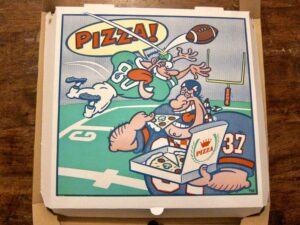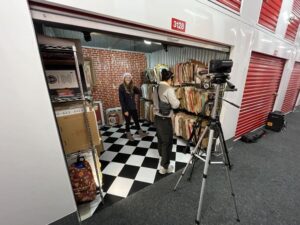

I’ve gotten some amazing pizza boxes from people all over the world but this just might be the best batch yet. Thomas sent some gems from Adelaide, Australia and Tobias delivered a pizza box that has been on my wish list for months. Also featured in this video are the eco-friendly GreenBox and Hybrid Pizza Box, which bring innovative ideas to the world of pizza box engineering.
Scott's Pizza Tour Pizza News
A Brief History of Pizza Boxes

Most pizza fans probably agree that pizza is best served directly from the oven, but over 1 billion pizzas are delivered each year and every single one of them is transported to its destination in a cardboard box. The contemporary pizza box remains as anonymous as it is simple, since few of its users know anything about the cardboard coffin’s humble origins. Let’s dig a little deeper into the history of the pizza box to provide some context for an item most of us view as a necessary evil in the life of a pizza eater.
In the early 1800’s, bakers were using copper containers to transport small breads and pizzas on the street. They often employed their sons to cart these stufas (literally stoves) around the neighborhood in hope of selling the scraps for some extra change. It was kind of like Newsies, but with much less singing and dancing. Unlike today’s model of made-to-order pizza delivered hot and fresh to your door, stufa boys were hawking pre-made pies. Stufas kept the pizzas warm, as copper has high heat dissipation capabilities. They also had pointed lids with covered vents to help manage steam exhaust. Brilliant!

The world’s first pizza box? This Stufa was crafted in a Neapolitan workshop.
Jump ahead 100 years and pizza starts to catch on in New York and other industrialized American cities. Legend has it that pizzas were being sold “to-go” rolled into a cone, wrapped in paper, and loosely tied with twine at Lombardi’s (America’s first licensed pizzeria). The small breads were often sold at room temperature and reheated on factory furnaces later in the day. This is early American take-out dining! There’s no evidence of stufa usage in America, but pizza was readily available at the bakery counters of any Italian immigrant neighborhood.
The post-WWII years exposed millions of American GI’s to pizza in Italy, so interest dramatically increased upon their return home. In the 1940’s, lots of pizza purveyors offered take-out pies. The pizza would sit on a stiff corrugated base, which could slide snugly into a large paper bag. The bag’s thin structure would allow steam to escape but only at the price of heat loss. Still, it’s not a bad means of conveyance. You can still find this method in use at Federici’s in Freehold, NJ (which has been bagging pies since 1946) and Vincent’s in Pittsburgh (since 1950).

Lillian of Passion-4-Pizza posing with a paper-wrapped pizza at Vincent’s in Pittsburgh.
The 1950’s brought pizza into the dining rooms of a booming nation and as orders piled up, so did the pizzas. Bags don’t stack very well and we didn’t even have that funky-little-white-plastic-dollhouse-table-pizza-box-support yet (more on that in a future post) so mankind was forced to adapt. Thin paperboard bakery boxes provided a bit more support, and so were born the earliest dedicated pizza boxes. Paperboard did the job for quite some time and remains in use today, but some folks aren’t satisfied. This material was never meant to withstand the intense moisture introduced by a hot pizza. The result is often a weakened box that collapses under its own weight.

A stack of empty paperboard boxes buckling under their own weight. [Photograph: Chuck Tuze]
One of the greatest leaps in the evolution of the pizza box can be attributed to Tom Monaghan, founder of Dominos. Since Dominos focused its business solely on delivery, it should be no surprise that they were the driving force behind pizza delivery technology. In order to deliver hot pizzas in a timely fashion, Monaghan searched for a company to develop a corrugated cardboard box in the mid 1960’s. According to Monaghan’s autobiography Pizza Tiger it was more difficult than anticipated to make a container that was scored properly for folding yet strong enough to hold its form. After a long development process with Triad Containers, a Detroit-based corrugated box company, they finally achieved success. The resulting pizza box has become a standard for the pizza industry right down to the way the box base doubles over itself to lock into the base, known appropriately as “Michigan style”. Regardless of how you many feel about the quality of their edible products, it’s hard to ignore the impact Dominos has made on the history of the pizza box.

Paperboard box (left) and corrugated box with “Michigan style” locking flap (right).
Even with all these years of innovation, we’re still just using a simple cardboard box to transport our beloved pizza. Have we taken the medium as far as it can go or is there room for improvement? Judging by the incredible array of new models at this year’s International Pizza Expo, we may be looking at a new era in pizza box evolution. Some pieces tackle the problem of heat loss while others challenge steam release issues. Wherever the world of pizza box design may be heading, it’ll be a long way from the copper stufas of Naples. Stay tuned for future posts on the technological updates in the pizza box industry.
Not only is this a pizza box from a pizzeria called Pizza Box, but the street name is also spelled wrong. AND they have a garden in the rear. So many levels of entertainment!
B-L-E-E-C-K-E-R
My pal Barbara always brings me pizza boxes from her travels abroad. Her last trip took her to Switzerland and Liechtenstein. She unveiled the goods as we were waiting for a large pie at Pizza Town USA in Elmwood Park, NJ.
New Pizza Box Shelf
My dad recently showed me his old coin collection. He keeps it in a series of books, each with its own pre-labeled compartments so he knows exactly which coins he’s missing and what doubles he has. How convenient!
I wish I had a collection that was so neat and tidy, but my stack of pizza boxes is quite the opposite. Some pieces (yes, I call them pieces) have scraps of cheese or grease splotches stuck to the lids, but that’s easily taken care of with a quick scrape and a spray of lacquer. For the past few months I’ve been way more concerned with storage options. With my flimsy over-the-desk bookshelf buckling under the weight of some 100+ pizza boxes, I decided it was time to take action.

First I had to examine and sort my collection. This was fascinating because most of these pieces have been sent to me by pizza tour alumni and relatives. I have boxes from Italy, the Czech Republic, the Netherlands, China, Australia, Canada, Turkey, Austria, Kazakhstan and more. I even have some limited edition boxes from pizzerias and pizza distributors!

All it took was about $15 worth of lumber and I was ready for action. Now my dangerously stacked pile is safely nestled in the unused airspace above my bedroom door! The only trouble is that now I have tons of usable pizza box storage space, so contact me if you find a sweet box and I’ll let you know about all the prizes I can give you for sending it my way.

[sorry for all the blurry cell phone photos but you get the idea]
Pizza Boxes at the International Pizza Expo
The International Pizza Expo is a massive trade show with everything from canned tomatoes to mozzarella-making demos to dough acrobatics and anything else you could possibly imagine relating to the pizza industry. I’ve been attending the Expo since 2006 and always find myself overwhelmed by the sheer magnitude of the room and the number of exhibitors it holds. Since I’m always researching multiple angles of the pizzaverse, entering the Expo floor feels like walking into a pastry shop and wanting to eat one of everything. It is truly amazing… and filling.

This year, I decided to limit my scope to just a few pieces of the pizza puzzle. Numero uno on my list was a tool we often take for granted but couldn’t live without: THE PIZZA BOX. I’ve been collecting pizza boxes from around the world ever since last year’s Slice Out Hunger fundraiser (we raised $1600 for City Harvest in just 2 hours with the help of an International Pizza Box Gallery) and my collection has grown exponentially since the event. I’ve learned a ton about the art, architecture and history of the pizza box, which all came together earlier this month at the pizza industry’s oldest and largest trade show.
First thing’s first, I saw the WORLD’S LARGEST PIZZA BOX! That’s right, this 54’ box is used by Big Mama’s and Papa’s Pizzeria to deliver gargantuan party pizzas to folks in the Los Angeles area. It’s manufactured by Whalen Packaging and requires direct shipping via flatbead truck to get to the pizzeria. The artwork is applied as a decal rather than printing directly on the box, so it’s extra clean and bright.

After a quick call to Big Mama’s and Papa’s on Hollywood Blvd in Los Angeles, I found out that the pie serves up to 60 people and costs $199.99 + tax as well as an additional delivery fee of $60. YIKES!
The megabox seemed to be the only over-sized piece on the show floor, with most manufacturers heading down the eco-friendly path of minimizing paper usage. New box designs are reducing paper consumption by 10-15% after eliminating unnecessary chunks of cardboard on the box flaps. Smurfit-Stone is the largest pizza box manufacturer in the US and their designers literally cut corners to reduce paper consumption and save their customers some cash.

As far as the eco-friendly pizza box is concerned, the undisputed leader is Ecovention, who showcased their GreenBox at the show. The lid breaks apart into four serving plates and the base folds into itself to become a storage unit for leftover slices. It’s a brilliant way to instantly reuse a pizza box and the visual design is super classy. GreenBox’s distributor, Roma Foods, even has their own branded GreenBox for nation-wide distribution, as does gourmet supermarket Whole Foods. My brother Jon is really excited about it.

Other innovative ideas came from Smurfit-Stone, who makes a box with a mylar heat-retention sheet under the hood. I’ve never seen one in action but I’d love to run some tests to see how it compares to the amazing iPack & Trade box I love so much. It looks like this one might trap a bunch of steam since there’s only one visible notch vent at the front of the box but I’ll try to get a sample and test it myself!

Pizza Box fever was on a real rampage this year. The show even had a Best of the Best Pizza Box Challenge, which awarded a cash prize for the best pizza box design. Voting was open to all show attendees but entries were limited to custom prints (no submissions from box manufacturers). Farrelli’s took home the prize (bottom row) but I thought there were quite a few decent submissions.

Sadly, the best boxes weren’t even in the contest. I’ll leave you with two of my favorites from the show floor. First up is an awesome ad-oriented box from Papa John’s (manufactured by Smurfit-Stone). PJ’s has lots of these limited edition boxes and I want all of them. Send me one and I’ll give you a prize!

And finally, the most talked-about box of Pizza Expo ‘11 hails from Milan and was used by reps from Via Tribunali in Seattle. I proudly present the pizza box you don’t take home to Mama:

I’m so confused by this scene because these four guys are just hanging out while there’s a babe holding a beautiful pizza Margherita just a few feet away. What a bunch of bozos!
The Evolution of Pizza Boxes in Naples
This is the third post in a series about my recent trip to Italy.
Just a couple weeks before my trip to Naples, I stumbled upon an incredible pizza box that completely changed my concept of the universe. Even though I collect boxes from all around the world, I’ve never been a big user of them myself because of a mountain of negatives. My crust gets soggy, the pie tastes like cardboard, and the dang thing is a pain in the tush to dispose of. I’ve always dreamed of inventing the perfect box that would correct these major issues, but my mission was rendered unnecessary the moment I found this modern marvel at Rossopomodo in Manhattan’s Eataly Italian superstore.
After posting a video about the box’s many features, I was invited to tour the manufacturer’s headquarters in Naples. I spent a day with the owner of iPack & Trade, Diego Rubino. It was one of the most amazing days of my life.

The beautiful photo-quality artwork on the box tops are super eye-catching, but the box’s technical functions are even more captivating. Diego explained that Italy has very strict laws regarding what materials are allowed to come into contact with food. Countries that produce paper products are usually light in restrictions because of a strong paper lobby. Since Italy is not a paper producing country, paper products are severely restricted. This is why some pizza boxes in Italy feature food-safe linings and advanced construction.
The big problem is that nobody wants to invest in such a fancy pizza box when low-end options are readily available. According to Diego, 95% of the pizza boxes in Italy are illegal because they have no barrier to protect food items from direct contact with recycled paper. In fact, Diego and his colleagues at iPack & Trade are so adverse to being lumped in with common box producers that they refer to their products as containers.
“Boxes are for carting things from place to place, not for delivering carefully crafted food” is Rubino’s general sentiment. Why put so much time and effort into crafting a perfect pizza only to damn it to a life sentence of sogginess inside a cardboard coffin? It’s simple: paper goods are the easiest piece of the budget to cut and iPack & Trade’s containers are roughly three times the cost of standard low end boxes.
Before heading to Naples, I was able to figure out most of the iPack’s features. There’s ample ventilation; the interior coating helps retain heat; containers are 100% recyclable; and the printing is super high quality. Tons of features, but I missed a few and Diego was more than willing to show me.
As Diego demonstrated, the innermost section is an extremely thin sheet of polyester. The purpose of this sheet is three-fold; it retains heat, deflects grease (keeping the materials recyclable!) and prevents food from coming into contact with recycled paper. This contact is fine for some foods but not when humidity or solvents such as oil and other fats are present. Pizza fails both tests, so particles of recycled paper break down in its presence. That’s why take-out pizza tastes like cardboard. He also showed me that only a thin film of water-soluble glue is necessary to adhere the polyester to the recycled paper, so running it under warm water for a few seconds is all it takes to separate the two materials for recycling. This polyester layer is extremely durable, so the standard pizza wheel cannot puncture it.
The final feature utilizes several cardboard tabs created by the opening of ventilation ports around the perimeter of the container top. These tabs form a “U” shape inside which an additional pizza container can fit. When stacking several pizzas, this has the effect of holding multiple containers in place.

There’s some pretty impressive stuff going on here but it’s all very simple. The heat retaining / humidity dispersing features of the container reminded me of an object I’ve seen in a few Neapolitan pizzerias around New York and Naples called a stufa (literally a stove). These little tubs were used to carry stacks of pizzas around the streets of Naples to be sold as snacks for a few cents apiece. Carrying them was usually the job of a baker’s son, who would hoist the copper case either on his head or tied over his shoulder. That’s right, it’s the world’s first pizza box.

It turns out that Diego used to be a stufa boy in Naples (although that’s not him in the photo) so this pizza box of the future is actually based on the archaic pizza box of the past. My pizza box collection wouldn’t be complete without a stufa so Diego tracked down the craftsman who makes them just a few blocks away. We made a quick stop, thanks to a call from Rossopomodoro’s CEO Franco Manna, and saw a freshly finished stufa as it was being prepared for shipping. This one wasn’t going back to New York with me, but I have a feeling I’ll be placing an order for the next round.

So keep your eyes peeled for amazing pizza containers from iPack & Trade. As of this moment they are only available at Rossopomodoro, with one location in New York and another in Naples, Florida. After my experience with Diego, I can honestly say I will never look at a pizza box… errr, container… the same way again.
This is seriously the coolest pizza box I have ever seen. I found it at Rossopomodoro in Eataly, the Flatiron district’s essential Italian food market. The pizza is pure Neapolitan, so it requires a truly unique box unlike anything I’ve ever seen before.
Some say it’s from the future. Some say it mirrors thermal principals of the past. Everyone agrees it’s rad.

Thanks to @pauliegee for the heads-up about the TSA’s pizza box top recruiting campaign. I really need one of these for my pizza box collection. Read more about the TSA’s recruiting campaign and send me a box if you find one.